
No Shave November and Fight Colorectal Cancer with Ben White
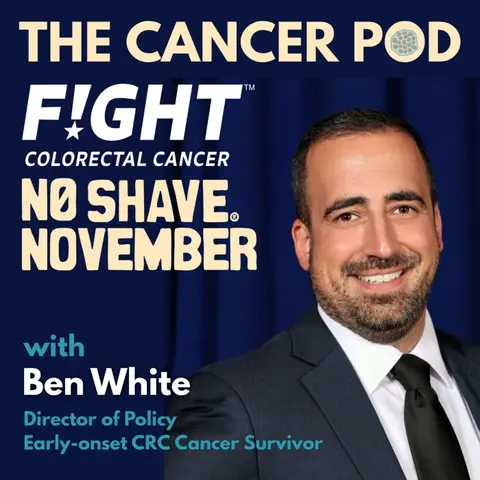


Support colorectal cancer research this November by skipping the razor! Fight CRC’s Ben White joins Leah to talk about No Shave November (no-shave.org) and the Fight Colorectal Cancer initiatives it supports.
Ben walks through Fight CRC’s work:
- No Shave November fundraising with partners
- March 2027 Call on Congress and advocacy for research funding
- The Global Early Onset Colorectal Cancer Think Tank
- United in Blue flag installations
- Insurance coverage gaps in the screening continuum
- Better symptom awareness for providers and the public
Ben’s own story is why he does this work. He was diagnosed with stage 3 colon cancer at 26 years old, after months of escalating GI symptoms and repeated dismissal as “too young.” His career pivoted from Navy pilot to health policy and he shares how his diagnosis brought him into the advocacy space.
Get involved:
- Sign up for No-Shave November
- Register for the 2027 Call on Congress
- United in Blue
- Order Flags for United in Blue
- Fight CRC Website
- Global Early Onset Colorectal Cancer Think Tank
Leave a message with your thoughts about the episode!
Become a member of The Cancer Pod Community! Support the podcast and gain access to exclusive content and more! Join today on Patreon.
Buy Me a Coffee and support the podcast!
Check out thecancerpod.com! Looking for more information? The website has blogs, merch, and all of the episodes listed by season and category.
Shop the Bookshop! The shelves at Bookshop feature books by authors who have been on the show and other fav books.
Buy The Cancer Pod merch! Whether it’s a cozy hoody or a handy water bottle, we have something for everybody.
Have a comment or suggestion? Email info (at) thecancerpod (dot) com
Follow @TheCancerPod on social media:
Become a premium member.
Join the #cancerinsiders. Membership includes:
-
A monthly (or so) newsletter packed with links to new episodes, compelling research, seasonal recipes, and practical health tips you’ll actually use
-
Behind-the-scenes updates
-
Bonus content from the podcast
-
Yoga videos to support your body and mind
-
Downloadable cheat sheets for quick reference
Join today!
Ben: No Shave November obviously kicks off in November, but if you wanna, you know, get a head start, you can create a team, start fundraising, and raise awareness that way. the goal is that it's something anyone can participate in. You don't, you know, have to have a beard or a mustache.
You could, skip your haircut, skip your, tweezing your eyebrows, whatever it is, you know, skip the leg shaves, for the month of November
Leah Sherman, ND: No shaving your legs...
Welcome to the Cancer Pod.
Leah Sherman, ND: Diagnosed with stage three colon cancer in his 20s while serving in the US Navy, Ben turned his personal experience into a national mission, serving as director of federal policy at Fight CRC. So how do you take a personal diagnosis and turn it into true legislative impact?
From grassroots advocacy on Capitol Hill with Call on Congress and the powerful United in Blue rally to the iconic No Shave November movement powering the fight for early detection and research. we’re talking about it all today and more
Ben, welcome to The Cancer Pod
Ben: Hi, Leah. Thanks for having me
Leah: before we start talking about some of the initiatives for Fight Colorectal Cancer, I want to kinda go into a little bit of your background and what brought you to the organization and a little bit about your diagnosis
Ben: Absolutely. Yeah. So I came to Fight CRC, as an advocate first. so I began volunteering with the organization probably in, what was it? 2018 or so, um, and had kind of volunteered with them for many years, before eventually, when I was, you know, working as a, a contractor writing government regulations in the Medicare space, they came to me and they said, "Hey, what are you doing?
You wanna come work for us full-time?" And I said, "Absolutely." Uh, and so I've been here full-time about two and a half years. But, that kind of conversation starts us in the middle of the story, so happy to kind of go all the way back to, where this began. So I myself, uh, am an early onset colon cancer survivor, so I was 26 when I was diagnosed.
Um, at the time, I was living in Jacksonville, Florida. I was a naval aviator, so I flew Navy helicopters for a living, and I'd just, just gotten my wings. I was like, I think I had my wings for like six months when I was diagnosed. So, I was, you know, young and in the shape of my life, which meant it was really hard to get a diagnosis.
I, uh, the signs and symptoms were slow to progress, and because I was in great shape and healthy and, and you know, so young, it was hard to be taken seriously and, and hard for many doctors to even consider something like colon cancer, um, even though I was exhibiting lots of red flag symptoms. So-
Leah: you have any history of colon cancer in your family?
Ben: I do not know. And so, you know, based on data we know now, about seventy percent of early onset colorectal cancer cases are sporadic, so we have no family history. I've had, you know, genetic panels done, and as of yet, we haven't found anything that would explain why I had this diagnosis. But no, no real family history or any reason why we would suspect this.
Um, but you know, as time wore on, I, I started to have more, you know, gastrointestinal distress. I was going to the bathroom many, many times a day, to the point where I was even, like, waking up in the middle of the night needing to have bowel movements, which isn't super typical. And I started to have abdominal pain.
I started to lose weight. That was really when things started to take a turn. I started to lose weight without trying. I was fatigued all the time. Um, and eventually it got to a point where I wasn't sleeping, I was weak, and I, I had to pull myself off the flight schedule. I, I went in for a briefing one morning and basically, you know, said, "Hey, I, I am not safe to fly right now.
Like, I need to go spend some time." I had been visiting the doctor trying to get workups, but it was like, this is a tipping point. It's too serious. And, you know, my, my doctor sent me for, like, a CT scan to see what was going on and, and I got a call the next morning at seven AM from my doctor, and he said, "Hey, man, you need to go to the ER right now.
It looks like a grenade went off in your colon. They know you’re coming, like, I sent you." And I get to the ER, and the surgeons come and they go, "Oh, you’re the guy? You look great." Like, "All right, it's gotta be, like, diverticulitis." And so they sent me home on antibiotics and, you know, we started this game of, like, me going back and forth to the ER every few days, couple of weeks.
Um, e-eventually it got to a point where my tumor actually obstructed my colon. and you know, I had actually had a couple inpatient stays at this point, where we still couldn't quite figure out what was going on. I never got a scope because the CT showed such inflammation that there was concern that we would perforate, so the goal was to kind of reduce inflammation and then see what was going on.
But, um, eventually, my tumor fully obstructed my colon. I sat in a lot observation while, um, kind of the doctor tried to figure out what to do, 'cause they still really couldn't get a clear picture of what was going on. And, um, eventually, you know, a, a new surgeon came on, on duty, uh, and said, "you’re not getting any healthier."
I was on TPN at this point. I wasn't eating. Um, he said, he said, "Let's go in laparoscopically and see what's going on." And so I went in for what was supposed to be a, a laparoscopic exploratory surgery, and I woke up with, um, you know, a colon cancer diagnosis and a, an ostomy. Um, so it was, it was a very jarring, challenging diagnosis to say the least.
Um, but it's not unique. I've talked to lots of people in the space who had similar challenges, and weren't diagnosed until things got pretty critical.
Leah: In my past with working, in cancer centers, I had a number of patients with, you know, not just colon cancer, but just all, all different kinds of cancer who were told, like, “you’re too young.” you know, either given antibiotics for whatever it was or just told, you know, “you’re fine. Come back in a year.” What... You know? So that's, that is scary say the least, that there isn't some sort of protocol to, to start working someone up and, and l- you know, put age aside
Ben: Absolutely. And, and this was, you know, I'm eight years cancer-free, and so my hope is that the space has evolved a little bit and that, you know, emergency providers and primary care physicians are more likely to, to catch something like this. But I even at one point, point-blank asked, uh, you know, a family medicine doctor and an internist,
Is that right? Internist? Uh, a hospitalist who was in, in... When I was inpatient, uh, when I was in there, you know, "Could this be colon cancer? Is that a possibility?" He said, "No, you’re too young. It couldn't be that." And that was, like, 10 days before this emergency surgery. Um, and it was just so far off of anyone's radar that this could be a thing
Leah: after your diagnosis, after your treatment, 'cause you went through surgery and chemotherapy, then you had the ostomy reversed.
Ben: Correct
Leah: and you said that you have been cancer-free for eight years now
Ben: Yeah. About, uh, over eight and a half years
Leah: Okay. Congratulations!
Ben: Thank you. Thank you
Leah: that is what led you to your advocacy, and now, you are towards your PhD healthcare policy?
Ben: Yeah. So it, it, it all actually really kind of started with, you know, I think thinking to that doctor who told me I was too young. When I did finally get my diagnosis, I heard a lot of similar things. The you’re an anomaly, there was a lot of expectation before the testing came back that I would have Lynch syndrome.
It was like, "Well, this is the only thing that could, could explain why you have this diagnosis at this age." And it turns out I, I don't have Lynch syndrome. Um, and, uh, they said, you know, "you’re, you’re-- This is so rare." And I said, "Surely this is not true." So I did what any, you know, millennial does, and I got on my phone and, and got on social media, and it turns out it was not true.
There were a lot of people posting about this and, uh, that's where I initially kind of got into the advocacy space. I found this organization called The Colon Club, um, that is an organization specifically focused on early onset colorectal cancer awareness and advocacy. And, um, I kind of got involved with that organization.
I went out and they used to do this thing called the Colondar like, kind of, uh, calendar where the goal was to, like, show off scars and show these are young people, you know, getting colorectal cancer.
And it's, it's evolved since then, but I, I joined and I got to be a part of, you know, what had it, h-had evolved into as, you know, like an annual attendee of their colon camp. Um, through colon camp, I found Fight Colorectal Cancer, Fight CRC, where I now work. Um, those two organizations have actually merged, so The Colon Club is a part of Fight CRC now.
It still runs every summer. new early onset patients get to go and, you know, have this camp experience and meet other survivors. Um, but yeah, it got me into the advocacy space and, uh, after my treatment, I was left with permanent neuropathy. Uh, so the Navy found me, you know, unsafe to fly, unfit for duty, and I, I had to figure out what's next.
Um, my undergraduate degrees were in political science and communication, so I, I had always kinda had a hunch that I was interested in the policy space. So I moved out to Washington, DC, and started working for a cancer nonprofit out here and applying to grad schools to get a master's in public policy degree.
And at that time, I w- I still was constantly astounded by the fact that people were saying, you know, "you’re too young. This, this isn't..." You know, I've keep, kept hearing that and kept meeting people who were told the same thing. And here we are 10 years later and it feels like, you know, a lot of patients are still hearing the same thing.
And, um, after getting my master's degree, I found I really was enjoying the research side of school work and I see a lot of gaps. I think there are so many gaps in the early onset space. there’s, lot of people still being told they're too young, and it's like almost been a decade now since I was diagnosed and, you know, what's changed?
so I, you know, I'm hoping to be the change I wanna see in the world and, and start doing this work. So I stayed in school forever. Uh, I'm in the dissertation phase of my health policy PhD and, and my dissertation looks at, um, you know, changes in screening uptake and down the road, you know, stage of incidence, after the change in the recommended screening age from 50 to 45, uh, that happened in 2021.
So I'm really interested in kind of the population health type research, tracking the trends, um, seeing, you know, when this policy change went into effect, what kind of downstream effects did we see? Um, and hopefully that can guide future policy changes
Leah: So what are some of the initiatives right now that Fight CRC is, is doing to, raise awareness? Uh, I should mention that March is Colorectal Cancer Awareness Month, and we’re, we’re talking, this is October when this episode is released, and there’s a reason for that. So, take it away, Ben. Tell us why we’re doing this in November!
Ben: Yeah, I, well, there’s two things, and I'll talk kind of-- We keep ourselves busy year-round. So the first thing I'm gonna talk about is No Shave November, and then I'll get to March. but No Shave November is much closer. Uh, and, and No Shave November is one of our big awareness initiatives where, you know, we ask people to, to put down the razor for the month of November.
Um, and, you know, the goal is hopefully those folks are maybe, you know, skipping the haircut, skipping the, the razor refills, and you, you donate that extra 5 20, 30 bucks, whatever it is, to No Shave November or start a fundraiser. and that, those d- those funds help go support, uh, you know, cancer research.
And, um, so we’re really excited about the launch of No Shave November. we also work with partners in this space, so it's not solely a Fight CRC initiative. So if you donate to No Shave November, you’re supporting three different organizations. you’re supporting Fight CRC, but also our partners at the Prevent Cancer Foundation, um, as well as Man Up to Cancer.
And so No Shave November obviously kicks off in November, but if you wanna, you know, get a head start, you can go to no-shave.org, um, and, you know, create a team, start fundraising, um, and raise awareness that way. And, and the goal is that it's something anyone can participate in. You don't, you know, have to have a beard or a mustache.
You could, uh, you know, skip your haircut, skip your, uh, tweezing your eyebrows, whatever it is, uh, you know, skip the leg shaves, for the month of November and, and raise awareness.
Leah: No shaving your legs...
Ben: You know, it's cold months. People aren't, people aren't looking anyway.
Leah: That's right, yeah. you’re wearing, you’re wearing l- long pants and tights so nobody needs to see your, your legs. so they can go to the website. You said no-shave.org?
Ben: No-shave.org. Correct
Leah: Okay. And they can find out more information and sign up there. And then I'm assuming also through, the Instagram site, the Instagram page, there’s probably a lot of information that's on there
Ben: Yeah, if you follow any of our No Shave socials, you'll see lots of information. Um, and our, and our partners also promote it as well, like I said. Um, you know, the proceeds don't just come to Fight CRC. you’re supporting three great cancer organizations who we work with in partnership in this program
Leah: like I mentioned, this is October. You do have something going on right now as well
Ben: Well, yeah. So our registration is open for Call on Congress in March. So March is Colorectal Cancer Awareness Month, as you had mentioned. And for us, you know, we spend all year working towards this, you know, with lots of stuff in between. But, um, this March 2027 is gonna be bigger than ever before. So every year, Fight CRC brings advocates to Washington, DC, um, to meet with their members of Congress and advocate for increased funding for colorectal cancer research in March at our annual Call on Congress event.
So this is an incredible time for, you know, survivors, caregivers, loved ones to come out and share their stories and, and share the real impact of colorectal cancer with, you know, lawmakers and people making these policies. This year, though, we’re super excited because we’re partnering with the Global Early Onset Colorectal Cancer Think Tank So this is a huge opportunity.
The, the Global Early Onset Colorectal Cancer Think Tank is another initiative that we work with where Fight CRC brings together researchers from around the globe who are leaders in the early onset colorectal cancer research space. And there’s really no one else doing this kind of work in this space.
Early onset colorectal cancer is a global phenomenon. It's not just happening in the US. It's, it's not, um, just something we’re seeing here. we’re seeing increased rates of colorectal cancer around the world in folks under the age of 50. Um, and so, you know, different countries are tackling this in different ways, so it's, it's really special to bring all these researchers together and make sure everyone's on the same page in identifying, you know, where we stand, what have we learned so far about this increase in early onset colorectal cancer, and where are the gaps?
Um, and so getting alignment on, on these issues and also coming together on, you know, next steps. So it's not just a one-time thing where we bring these researchers together and we say, "Great job." Um, they actually come together, and it's, it's a working time to create a plan for what the next two years they're gonna be working on together, uh, before they come to the next think tank.
So, it really is kind of sets the stage for all these researchers meet, you know, monthly, bimonthly for the next two years on whatever projects they've decided on together at our think tank, um, and continue to do that work together. And, and this is gonna run in DC at the same time as, alongside Call on Congress.
So our advocates get to come out and speak to their members of Congress about the importance of research funding at the same time as those researchers who are doing this work are meeting together to, you know, talk about where the gaps are and what is next. And so having that opportunity for all of them to, you know, be in the same room at certain times, they are separate events, but we do have some co-programming already scheduled, um, is super exciting.
And with this, it means our Call on Congress event has changed. It used to be kind of open to anyone, as many advocates who wanted to come could. But obviously, the changes, uh, of adding the think tank mean we have some capacity changes and things like that. So we will have an application process this year.
It's, it's open now that it's, uh, you know, October first. Um, and it's first come, first served, but we just have it first come, first served within states. So our goal is to make sure that we have all 50 states represented. We don't want, you know, all of the first huge chunk of applicants to end up being one state and then other people from, you know, states who apply later not get in.
So that's really the reason for the application process this year, is just to make sure we have representation geographically, as we do Call on Congress in 2027.
Leah: I wanna talk about United in Blue as well, because that is something that also happens in March, and it's, it's pretty powerful
Ben: Yes. Thank you for raising that. So United in Blue is also happens in March alongside of Colon Congress and this year, Think Tank. and it is, you know, the largest colorectal cancer awareness installation that we’re aware of, you know, i-in person. And, and so what it is, is every year, volunteers come out and place over 27,000 flags on the National Mall in front of the Capitol in the US.
And these flags represent, the number of cases of early onset colorectal cancer that are gonna be diagnosed by the year 2030. And, and that was the stat that originally was what started this event. I think we have already surpassed, you know, the-- as cases have continued to rise, the, the modeling has changed, so we still plant those 27,000.
Um, but, you know, it's, it's even more urgent than it was when we initially started doing United in Blue. But it's a really incredible event. we have, you know, edu-- in addition to the flags, there’s lots of educational pieces that go along with it. So if you walk the mall in person, um, you know, you can learn about early onset colorectal cancer.
We always encourage, you know, members of Congress and, and people in DC to come participate. and then in addition to the DC installation, folks can participate from home, and that's kind of a theme we’re running across March this year is, uh, everything we’re doing in DC, you can also do at home. So you can order your own flag kit and plant flags in your own yard or your, your business, your place of work to raise awareness.
we can help you have, you know, set up meetings with your members of Congress back at home when they're on recess, if you aren't able to come to DC, you know. you can share your story on the Fight CRC website, and we can make sure that your representatives and members of Congress hear that story in the same way that they will hear those stories of people who are coming to DC in person.
So, um, United in Blue, a big awareness event, but not just limited to Call on Congress. It's, it's everywhere in March, and that's really all of March, all of our awareness we’re trying to expand so that anyone can participate in these events from their own community
Leah: So going back to some of the policy changes that you would like to see, I actually have a friend who talks a lot about ... He is a young cancer survivor. Um, he had lymphoma, and he is very big advocate for that, like, anyone who has a history, any young person who has a history of cancer in general should be able to get certain screenings and have it covered by insurance, one of them being, you know, being checked for colon cancer.
And so what are your thoughts on that? Like, is that something that you’re working towards?
Ben: We do a lot of work in both the screening and research space. Um, you know, personally, the way I see colorectal cancer is it's, it's kind of a two-front fight. So In the Affordable Care Act has a preventive service provision that requires all screening recommendations that fall under the United Services Preventative Task Force A or B recommendations to be covered at no cost, uh, to patients who are of average risk.
So these are our folks who are above the age of forty-five now, um, and don't have, you know, a personal or, or family history of, of colorectal cancer. They should have access to colorectal cancer screening at no cost. And so i-in that space, our goal is just to get everyone screened. Um, it should be no cost to you if you have insurance, and if you don't have insurance, a lot of states, are starting to roll out programs to increase access.
That's a place we work in the state spaces, you know, helping increase access for under- and under-insured folks as well. and there are still a lot of gaps, though. So, you know, for many years, there were challenges where people were getting a screening colonoscopy, but they would find a polyp, and it would be coded as diagnostic, and then they would face a copay.
Well, that was, a loophole we closed in twenty twenty. Um, that was something our advocates did for many years at Calling Congress to close that loophole. Now we have concerns where we have all these new screening modalities, which it's a really exciting time. We have all these non-invasive, you know, we have stool DNA, stool RNA tests coming to market.
We have blood tests. All of these tests, though, still require a follow-on colonoscopy if there’s an abnormal non-invasive test. So, you know, if you do your, your, um, your at-home test and, and it-- something is off, you still have to get that colonoscopy. And in, in some cases, patients are still paying out-of-pocket costs for that follow-on colonoscopy, so we've done a lot of work to close that gap as well to ensure that the entire screening continuum patients are not paying out-of-pocket costs.
So that's kind of how we see screening above forty-five. The other space we talked about a lot is the early onset space, where, um, you know, the, the, the population health, the cost benefits aren't quite there to screen everyone under forty-five yet. We-- The tipping point hasn't crossed according to the experts making the decisions to, to lower the age again.
So for there, we’re looking for, you know, increased awareness. Um, that's why these awareness and education and things like United in Blue matter so much, and increased research to create, you know, more cures, more time for patients who are facing these diagnoses. Um, so, you know, in the research space, some of the priorities we tackle are, are increased funding broadly for National Cancer Institute, NIH.
and then there’s... W-when we, when we talk about funding NIH, Congress doesn't line by line direct, you know, how much each type of cancer research gets. They fund NCI as a whole, and NCI internally determines, you know, where to set its priorities. There is a place within Congress where they can specifically determine line items of, of how cancer research is funded, and that's called the Congressionally Directed Medical Research Program.
Um, so it actually falls under the Department of Defense Uh, as far as how funds are allocated. But it's been a longstanding program for many years. colorectal cancer is eligible for funding under what's called the Peer-Reviewed Cancer Research Program. That means there’s a big bucket of money for about 20 plus cancers, and any researcher applying for these funds has to kind of compete against all the other cancers.
That said, there are many cancers that have their s- own standalone program. So, you know, breast, lung, pancreatic, they all have standalone programs where there’s guaranteed funded, funding each year that funds these cancer research projects. and so our goal is to get a standalone colorectal cancer research program.
It's the only cancer that falls into top five for incidence and mortality in the US that doesn't have a standalone program. Um, and so that's the focus of our Call on Congress ask is, to get a standalone cancer program created within the congressionally directed medical research programs.
Leah: how can one awareness amongst physicians so that people like you, people like my patients have to hear the words, "you’re too young to have cancer"? How, where, how does that come in in terms of creating awareness?
Ben: It's a great question, and it's, it's definitely one of the places where I think there’s work to be done. Um, you know, the, the primary care physicians and i- in, in the case of early onset patients often, you know, emergency physicians are, are kind of the gatekeepers here. And I, I think it's fair to recognize that primary care physicians, uh, primary care providers as a whole are expected to do so much with so little time.
Um, you know, how many patients under 45 even go get their annual physical, and how many things are they meant to get screened for in that time? Um, so I think it's fair to, to acknowledge that there is a capacity and a limitation there. That said, uh, awareness on that front's huge because they're the first line of defense when a patient is, you know, coming and presenting these symptoms.
They're the ones who need to recognize, "Oh, you know, n- not typically of an age I would expect colorectal cancer, but it is something to think about." Um, and so, you know, that's a space we do kind of a lot of... We call it like little P policy work. Uh, we call big P policy work the, like, trying to change laws, things like that.
Little P policy work is kind of the system change, where we’re working with health systems and, and, you know, providers on, on education and increasing, you know, how they're tracking these kinds of things. Um, it-- but it is, it is a big gap, and, uh, I think that it's part of the reason that, you know, right now, about 75, three in four, 75%, three in four patients who are early onset are diagnosed at a late stage.
and it comes down to early, early recognition, and it, it comes to both, uh, you know, provider education and, and certainly public education, 'cause I think a lot of times people in these populations don't recognize these symptoms are concerning until, um, they become very concerning. You know, I can-- That was my experience.
Personally was, it was very easy to write off my symptoms until suddenly it was, like, huge red flags, and then you’re starting the process late in the game already, and medicine and health workups take time, and you’re fighting an uphill battle at that point. So earlier symptom recognition on patient end is important too.
Leah: Yeah, because once an ER doctor is brought into it, the symptoms are bad the person went to the ER. I mean, at that s- at
Ben: Right
Leah: like you’re saying, it's, you know, it's, it tends to be a later stage.
Ben: I, I talked a little bit about big P policies and little p policies, so, you know, that's-- I don't know, uh, that's just what we call it internally, but I, I think it's fair, a, a fair distinction.
And, you know, big P policies being like changing laws, changing coverage, things like that. Little p policies, um, our biggest place we’re working on that is called our Colorectal Cancer Care Initiative. and, and so what that is, is we are working with partners across the colorectal cancer space with the goal of increasing screening and quality of care for patients.
And what this really comes down to is, setting goals for specific things that health systems and, and providers can measure, um, that aren't necessarily currently being measured that will improve access to screening or quality of screenings as well as quality of care. so, you know, the inception of this was a really cool thing.
It happened, um, in twenty twenty-one or twenty twenty-two. We went to the White House with a large group of colorectal cancer, you know- Advocacy organizations, not just Fight CRC, partners in the screening space, researchers, healthcare providers. Um, you know, this was a, a part of the Biden Cancer Moonshot at the time to talk about gaps in the space.
And, and where we landed was that there are some things we need to be measuring that we can't even, we can't even tell how we’re doing in some of these spaces. And after, you know, years of work and iteration of, you know, making sure that there’s-- everyone was on board with, you know, where, where are the biggest gaps and where can we make an impact?
We created this colorectal cancer care initiative, and it has, uh, two specific goals in the, the screening and care space, and there are five specific items we’re looking to measure and increase in that space. And so one of them has been longstanding, increase everyone who is, you know, average risk above the age of forty-five, get eighty percent of those folks screened for colorectal cancer.
that has been a longstanding goal. It was set by the National Colorectal Cancer Roundtable, and we’re still not quite there yet nationally. Um, and so it's still something we’re striving towards. But now with the addition of these non-invasive tests, we've added the goal of making sure that eighty percent of abnormal non-invasive screening tests get a follow-on colonoscopy within ninety days.
Other goals we’re-- that are included in our care initiative are, um, ensuring that patients have access to both, genetic germline testing as well as biomarker testing, as fall within NCCN guidelines, and then finally, timely initiation of treatment after a diagnosis. Um, so we have health systems and partners, you know, endorsing these goals and signing on and agreeing that these are things they agree are important and are gonna start working towards measuring and tracking.
one win we've had in this space is that, there was actually a new quality measure, um, to get real wonky in the policy space, but there, there was a new HEDIS measure rolled out, so starting in twenty twenty-seven, health plans will be required to measure, the amount of patients who are receiving that follow-on colonoscopy.
Um, so the, the system is starting to move. we’re starting to get things in motion of real measurement and tracking and accountability for, you know, this is at the, um, you know, the in-insurer levels that this measure is going in, but hoping to get, you know, providers and health systems on board to start tracking these things as well.
Because the first step is measurement. We can't improve if we don't know where we are.
Leah: So when you were talking about, um, the majority of young adults who are diagnosed with colorectal cancer have no family history at all, no known genetic mutation, but the, the screening age doesn't start until 45 I'm assuming, I'm not up to date on guidelines, but if you do have that family history, if you have a family history of colon cancer, uterine cancer, any sort of, strong family history, you would start your screening earlier, right, than Then 45
Ben: Correct. Uh, per most guidelines, typically if you have a family history, you would start screening 10 years prior to, whatever that closest family member, I mean, typically it's immediate family, um, had their diagnosis. So, you know, my daughter, uh, unfortunately will get to start her colon-- first colonoscopy at age 16.
I'm sure she's gonna love me for that. Uh, but that is typically you,
Leah: So it's,
Ben: you do wanna start screening early.
Leah: So yeah, so it's 10 years the, the youngest person, you being 26, it's 10 years prior to that diagnosis age that the screening needs to start
Ben: Correct. Correct. Um, and, and there’s a challenge too where a lot of people don't necessarily know they have a family history. Um, so, you know, that's, that's another piece of the awareness push is getting people to talk about that. There is certainly a stigma around colorectal cancer where people don't like to talk about it.
there’s, there’s just stigma against it, and so working to break down those stigmas and those barriers and at least have people talking about these things so that, um, you know, their family members don't also have to face these diagnoses is something we work on as well.
Leah: Yeah, and, you know, as we were saying, I think, you know, not only creating, uh, more awareness amongst physicians, but definitely amongst just younger people in general to, to start asking those questions about, you know, family history, and then to start talking to their doctors about getting those screenings.
'Cause there are very specific guidelines for people who have, um, you know, like you were saying for Lynch syndrome or for BRCA or, um, Li-Fraumeni. Like, there are, you know, there are more rigid guidelines. But for somebody who, you know, doesn't have that sort of cluster family history of immediate relatives, maybe they just have, you know, one relative, they need to be aware themselves if, if their relative isn't, hasn't been told, if their parent hasn't been told
Ben: Yeah. And, and it's, it's challenging in this space too because there is, there’s kind of this perverse incentive of screening where only average risk individuals have no co-pays, no out-of-pocket costs. So it's definitely important that people talk to their providers and understand, you know, where-- how close is that relative to you and where does that mean on guidelines when you should start.
Um, and it's, it, it is a very big, you know, a very big problem to tackle and it's something that I think a lot of people in the, the preventive space and screening space are talking about. But yeah, there is a, you know, if you, if you have a pre-existing condition, if you have one of those, you know, Li-Fraumeni or, or Lynch, or you have a personal or family history, um, you actually are no longer of average risk, and now you face those out-of-pocket costs for screenings.
and so it's very complex, the, the screening space. Um, and it's, it is challenging 'cause we tell people we want them to know about their family history, and you wanna get screened early if you’re at high risk, but that also means you have to pay out-of-pocket costs. So, um, you know, it's, it's definitely something people should be talking with their providers about and, and making sure they're going in clear-eyed about these things too, because sometimes people are a little shocked when they say, you know, "I was told to screen early," and then suddenly you’re faced with co-pays that you weren't expecting.
Leah: Yeah, that makes things challenging in terms of early detection i- in somebody who's high risk. I mean, that just, that seems a little, um back asswards? I don't know what you would say.
Ben: I, I use the term perverse incentive, but yeah. Um, it's challenging and it's, and it's such a big problem because it's like the, the average risk thing is baked into the Affordable Care Act and the law, and it, and it's, it's a big lift to change. But it's definitely something that I know, you know, physicians and groups in the GI space as well as us are, are thinking about.
Um, and it's, it's a big bite to chew, but we’re, we’re trying to take nibbles out of it wherever we can to increase access
I would just wrap with one more plug to, you know, put down that razor and, and, uh, consider starting a, a fundraising page and, and joining No Shave November. Um, it's a really fun way to raise awareness for cancer.
and like I said, I, I think you get a lot of bang for your fundraising buck in that you get to support three fantastic organizations, um, in one go with this event. Um, and you know, it, it'll keep you warm as you enter the winter months
Leah: It's, it's a great excuse if you've been wanting to grow a beard or just kind of, you know, throw away that razor. It's a, it's a perfect excuse to, to do that and a great way to raise money
Ben: Absolutely
Leah: Well, thanks so much for joining me, Ben
Ben: Thank you so much for having me
Thanks for listening to The Cancer Pod. Support the show by following wherever you stream podcasts. Remember to leave a review and share this episode with someone you love. Join our Patreon community for bonus episodes, free downloads, and behind-the-scenes conversations. Follow The Cancer Pod on social media for more integrative wellness insights between episodes.
This podcast is for entertainment purposes only and is not medical advice. Always talk to your healthcare team before making any changes to your treatment plan. And on that note, I'm Dr. Leah Sherman. Music is by Kevin MacLeod.


